

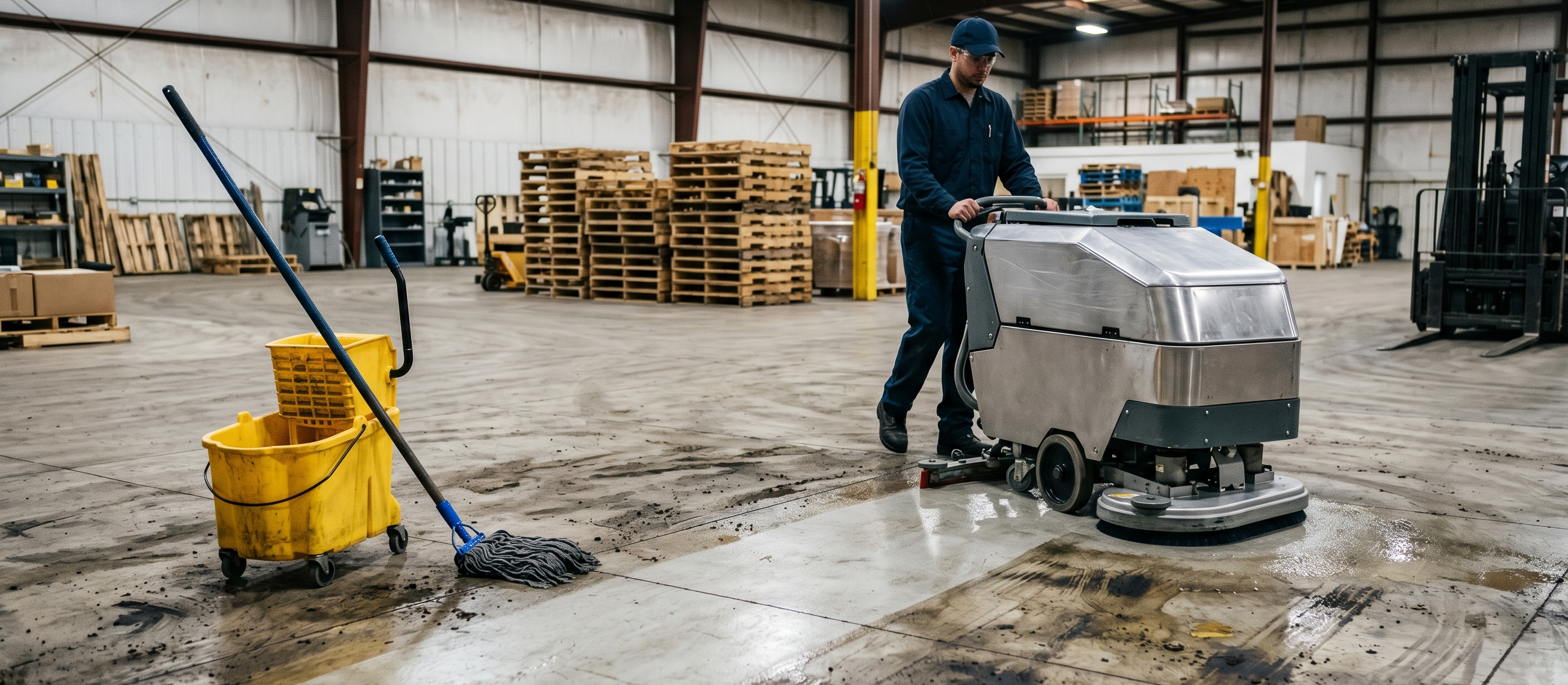
If you are paying staff to clean a warehouse or factory floor with a mop and bucket, you might as well pay them to paint the dirt back onto the floor.
It sounds harsh, but in an industrial setting, mopping is obsolete. It is slow, it is dangerous, and scientifically speaking, it doesn't actually clean.
We often visit facilities where a pristine Two-Pack Floor Coating looks dull and grey after just six months. The manager blames the paint. We blame the cleaning method. The floor isn't worn out; it is covered in a microscopic film of dirty water that dried in place.
Here is the breakdown of why manual mopping fails in commercial environments and why a Floor Scrubber Dryer is the only way to protect your investment.
The Problem with Mopping
When you dip a mop into a bucket, the water is clean for exactly one pass. For the rest of the shift, the cleaner is dipping a dirty mop into dirty water and spreading a grey "slurry" of grease and grit across the floor.
-
No Extraction: A mop doesn't lift the dirty water off the floor; it just thins it out. When the water evaporates, the dirt stays behind.
-
Safety Risk: Mopping leaves the floor wet for 15–30 minutes. In a busy warehouse, that is a massive slip-and-fall liability.
-
Chemical Residue: As the dirty water dries, it leaves a chemical haze that kills the gloss of your Industrial Floor Paint.
The Scrubber Dryer
A Scrubber Dryer machine changes the physics of cleaning. It performs three actions in one pass:
-
Inject: It sprays a clean mix of water and Industrial Degreaser onto the floor.
-
Agitate: A heavy rotary brush mechanically scrubs the floor, lifting dirt from the texture (profile) of the concrete.
-
Extract: A vacuum squeegee at the back sucks the dirty liquid up immediately into a separate tank.
The Result: The floor is scrubbed with fresh water every inch of the way, and - crucially - it is bone dry the moment the machine passes. No slip hazards. No residue.
Do Not Use Dish Soap
This is the single most common mistake we see with machine cleaning. If you put high-foaming household detergent (like dish soap) into a scrubber dryer, you will destroy the machine. The foam fills the recovery tank and gets sucked into the vacuum motor, burning it out.
You must use a specialized Low Foam Detergent or a dedicated machine-grade Traffic Film Remover. These chemicals are designed to cut through forklift tire marks and oil without creating a mountain of bubbles.
The Labour Calculation
A scrubber dryer is expensive to buy, but cheap to run.
-
Mopping: A cleaner can mop roughly 200 sq meters per hour (poorly).
-
Machine: A ride-on scrubber can clean 3,000+ sq meters per hour (perfectly).
If you have a facility larger than a tennis court, the labour savings alone usually pay for the machine within 18 months.
Conclusion
You spent thousands installing a professional Industrial Floor Coating System. Don't let a £5 mop ruin it.
If you want your floor to keep its gloss and grip, you need to remove the dirt, not just rearrange it. Invest in a scrubber, use the right Industrial Degreaser, and your floor will look brand new for years, not months.
Share:
Degreasing Concrete: How to Remove Oil Stains Before Painting
Acid vs. Alkaline Concrete Cleaners: Which Do You Need?